Your air conditioner is running, the compressor is humming, and the display says it’s set to cool, but barely a trickle of air comes out of the vents. The room stays warm, the system keeps running, and the whole thing feels like it’s working harder than it should for next to nothing.
Air conditioner weak airflow is one of the more confusing faults Australian homeowners deal with because the system appears to be operating normally. There’s no obvious error, no strange noise, no water leak. It’s just not moving enough air. The cause can be something as simple as a clogged filter you can clean in ten minutes, or something more involved like a failing fan motor that needs a licensed technician.
This guide works through every common cause in the order you should check them, tells you what’s safe to do yourself, and helps you recognise when it’s time to stop troubleshooting and book a professional.
Why Airflow Matters So Much
Before working through the causes, it’s worth understanding why airflow is so central to how an air conditioner performs.
Your indoor unit doesn’t just produce cold or warm air and send it out. It draws room air across the evaporator coil, conditions it, and recirculates it. The volume of air moving through that process at any given time directly determines how effectively the system changes the room temperature.
Air conditioning depends on airflow. If the system cannot move enough air through the indoor unit and into the room, comfort drops even though the equipment may continue running.
When airflow is restricted, several things happen simultaneously: the room takes much longer to reach the set temperature, the system runs continuously trying to compensate, electricity consumption rises without a corresponding improvement in comfort, and the evaporator coil can drop below freezing, causing ice to form, which makes the airflow problem dramatically worse in a short period of time.
A weak airflow problem almost always costs you money even before it causes a visible fault. Getting it resolved quickly matters.
Step 1: Check the Obvious Things First
Before assuming a component has failed, work through a short checklist. A meaningful number of “weak airflow” calls turn out to be one of these.
Check the fan speed setting. Most split system remotes allow you to select fan speed independently of temperature. If the system is set to low or quiet fan mode, that’s exactly what it will deliver. Check the remote and set it to auto or high, then reassess whether the airflow changes.
Check the mode. A unit running in Dry mode operates the fan at a significantly reduced speed to dehumidify rather than ventilate. If someone switched modes and forgot about it, this produces exactly the low-airflow symptom you’re experiencing.
Check that nothing is physically blocking the indoor unit. Curtains draped across the front, furniture pushed too close underneath, or decorative items sitting on top of a wall-mounted unit can all restrict the air it draws in and delivers. The indoor unit needs clear space in front of and below the intake area to draw in room air properly.
Check the outdoor unit is running. Go outside while the system is operating. The outdoor unit should be running whenever the indoor unit is in cooling or heating mode. If the indoor unit is blowing but the outdoor unit is completely silent, that points to an electrical fault or compressor issue rather than an airflow restriction.
If all of those check out and the airflow is still noticeably weaker than it used to be, move to the causes below.
Cause 1: Clogged Air Filter
This is the most common cause of weak airflow in Australian homes and the first thing to check every time.
Air filters play a crucial role in your AC system by trapping dust, allergens, and other particles from the air. When filters become dirty or clogged, they restrict airflow, which can lead to weak airflow from your vents.
The change is usually gradual. Filters don’t block overnight; they accumulate dust and debris over weeks of use. The airflow loss is so slow that many homeowners don’t register it until the room takes noticeably longer to cool or heat, or until they hold a piece of paper in front of the vent and watch it barely flutter.
A dirty filter may be straightforward to correct. If airflow remains weak after cleaning it, the problem may involve the fan, controls, ductwork or another part of the system.
Signs this is your problem:
- Airflow has declined gradually rather than suddenly
- You can’t clearly see light through the filter mesh when you hold it up
- There’s more dust on surfaces around the indoor unit than usual
What to do:
Switch the system off at the wall, open the front panel of the indoor unit, and remove the filter panels. Take them outside, shake off loose dust, then rinse under warm running water from the back side of the filter so you’re pushing dirt out the direction it entered. Let them dry completely in the shade before reinstalling.
Our step-by-step guide on how to clean your air conditioner covers the full process in detail, including what to check beyond the filter, and how often to do it depending on your usage and environment.
After reinstalling the clean, dry filters, run the system and check whether airflow has returned to normal. If it has, you’ve found the cause. If airflow is still noticeably reduced, move to the next cause.
Still Getting Weak Airflow
After Checking the Filter?
If cleaning the filter and clearing the vents hasn’t restored normal airflow, the problem may be inside the fan, coil, ductwork or another system component. Have it professionally inspected before the issue gets worse.
Cause 2: A Frozen Evaporator Coil
A frozen evaporator coil is often caused by a clogged filter, which is why this cause follows directly from the one above. When the filter is restricted, less warm room air reaches the coil, the coil temperature drops below freezing, and moisture begins to freeze onto the coil’s surface. Once ice forms, it acts as an insulating barrier that progressively worsens the airflow restriction in a self-reinforcing cycle.
The symptom is a unit that produces very little airflow despite appearing to run normally, sometimes accompanied by water dripping from the indoor unit when the system cycles off as the ice melts.
Signs this is your problem:
- Very weak airflow from the vents despite the unit running
- Ice or frost visible on the indoor coil when you open the front panel
- Water dripping or pooling under the indoor unit, particularly when the system turns off
- The air that does come out may feel warmer than expected because the frozen coil can’t exchange heat properly
What to do:
Switch the unit off completely at the wall. Do not just put it on Fan Only to try to defrost it faster, as this adds load to a fan motor already working against restricted airflow. Place towels beneath the indoor unit to catch melt water. Allow the coil to thaw fully, which takes one to three hours depending on how much ice has accumulated. Never attempt to chip or scrape ice off the coil.
Once fully thawed, clean the filters if you haven’t already, then restart the system and monitor. If the coil freezes again after a clean filter is in place, the underlying cause is something beyond dirty filters, most likely low refrigerant, and that needs a professional diagnosis.
For a full explanation of why coils freeze and what each cause means, our guide on why your air conditioner is freezing up covers the complete diagnostic process.
Cause 3: A Dirty or Fouled Evaporator Coil
The filter catches most of the airborne debris before it reaches the coil, but over time a thin film of dust, pollen, and biological matter builds up on the coil fins themselves. This layer of fouling reduces the coil’s ability to transfer heat and, in more significant cases, partially restricts the airflow path through the coil.
This is distinct from a frozen coil. The coil may look clean at a glance but feel slightly tacky or discoloured on closer inspection. The airflow reduction from a fouled coil tends to be gradual and accompanied by a noticeable drop in cooling or heating performance alongside the reduced airflow.
What to do:
Cleaning the evaporator coil beyond the filter area requires appropriate coil cleaning solution and access to components that shouldn’t be opened without training. This is a professional service task, included in a standard annual professional service. If your system hasn’t been serviced in more than 12 months and airflow has been gradually declining, coil fouling is worth suspecting alongside a dirty filter.
Cause 4: Blower Fan Problems
The blower fan inside the indoor unit is the component physically responsible for moving air through the system. If it develops a fault, airflow drops regardless of how clean the filter and coil are.
The blower fan is responsible for pushing cool air through your ducts and into your living spaces. If the fan is malfunctioning or damaged, it can result in weak airflow.
Fan problems in residential split systems typically fall into one of three categories:
Capacitor failure. The capacitor provides the starting and running torque for the fan motor. A failing capacitor causes the motor to run at reduced speed, producing noticeably weaker-than-normal airflow. The fan sounds like it’s running but just isn’t moving much air. This is a relatively inexpensive repair when caught early.
Motor bearing wear. As a fan motor ages, the bearings can wear and create additional friction that reduces the motor’s speed and efficiency. This is often accompanied by a grinding or squealing sound from the indoor unit. Left unaddressed, a motor running on worn bearings will eventually fail completely.
Damaged fan blade. A cracked, bent, or debris-struck fan blade affects the volume of air the fan can move per revolution and sometimes creates a rattling sound during operation.
Signs this is your problem:
- Airflow dropped suddenly rather than gradually
- The unit is making a new noise (grinding, squealing, rattling) from the indoor unit
- Airflow feels weak even immediately after cleaning the filters
- The unit has been running for several years without a professional service
What to do:
Fan motor, capacitor, and blade issues are all jobs for a licensed technician. The fan assembly is located inside the indoor unit behind the coil, and accessing it requires partial disassembly of the unit. This is not a DIY task.
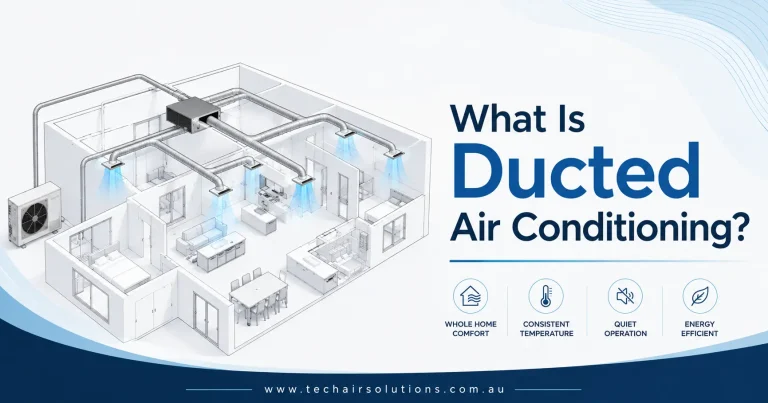
Cause 5: Blocked, Leaking, or Collapsed Ductwork (Ducted Systems)
If you have a ducted air conditioning system and the weak airflow is affecting the whole home rather than a single room, the cause may be inside the indoor unit or ductwork rather than at the vents themselves. But if airflow is weak in one or two rooms while the rest of the home is fine, the duct network serving those specific zones is the most likely culprit.
Ductwork is responsible for transporting cool air from your AC unit throughout your home. If there are leaks, blockages, or damage in your ductwork, it can lead to weak airflow.
Common ductwork issues include:
Duct joint separation. Flexible ducts in roof cavities can sag, pull apart at joints, or become kinked over time, particularly in homes where the ductwork is more than ten years old. When a duct partially separates, conditioned air leaks into the roof space rather than reaching the room below. The affected room gets much weaker airflow while the rest of the system continues operating normally.
Collapsed or kinked flexible duct. Flexible insulated ductwork can be compressed by stored items in the roof cavity, or it can develop a tight bend that restricts airflow to the vent below. This is surprisingly common in homes where the roof cavity is used for storage.
Debris or pest activity. In some cases, nesting material from birds, rodents, or insects can partially or fully block a duct run. This creates strong airflow at most vents and very weak flow at the affected outlet.
Zone damper fault. Ducted systems with zone control use motorised dampers to open and close airflow to specific zones. A damper that has jammed in a partially closed position will reduce airflow to that zone regardless of how the controller is set.
Signs this is your problem:
- Airflow is weak in one or two specific rooms while the rest of the house is fine
- A particular zone has been progressively harder to cool or heat over time
- You can hear the system operating normally from the return air grille but specific vents produce very little output
What to do:
Ducted systems add another layer because airflow has to travel through ductwork, dampers, zones and outlets before reaching each room. The pattern of the problem can help with diagnosis. Weak airflow throughout the property suggests a different set of possibilities from poor airflow at a single outlet.
For duct access, inspection, and repair, you’ll need a licensed HVAC technician who can access the roof cavity, inspect the duct runs, and identify the specific point of failure. This is not a DIY job for safety and access reasons.
Get Your Air Conditioner
Moving Air Properly Again.
Weak airflow can reduce comfort, increase running time and put extra strain on your system. Tech Air Solutions can diagnose the cause and get your air conditioner performing as it should.
Cause 6: Blocked or Obstructed Vents and Grilles
Blocked vents can significantly reduce airflow in your home. Furniture, curtains, and other objects can obstruct vents, preventing conditioned air from circulating effectively.
For split systems, the return air path matters as much as the supply air path. The indoor unit draws air back from the room through louvres on its underside or front face. If furniture is pushed directly below the unit, or curtains are drawn across it, the unit is trying to draw in air through a restricted opening, which reduces total airflow regardless of how clean the filter is.
For ducted systems, the return air grille (the larger ceiling grille that draws room air back to the indoor unit) is a common culprit. A return air grille that hasn’t been cleaned in a while, or that has been partially covered, reduces the total volume of air circulating through the system.
What to do:
Check all supply vents are fully open and unobstructed. Check the return air grille is clear and clean. For ducted systems with adjustable zone vents, confirm that the weak-airflow rooms haven’t had their vents accidentally closed or turned down.
On split systems, vacuum the louvres on the front face of the indoor unit using a brush attachment to clear surface dust that restricts the intake path.
Cause 7: Low Refrigerant
Low refrigerant doesn’t directly restrict mechanical airflow in the way a dirty filter or fan fault does, but it does affect how the system conditions the air it moves, and the knock-on effect can feel very similar to a weak airflow problem.
If your system is low on refrigerant due to leaks, it may struggle to cool the air effectively. Ice formation on the evaporator coils is a common sign of refrigerant issues.
When refrigerant charge drops below the specified level, the evaporator coil operates at lower-than-designed pressure and temperature. The coil becomes unusually cold, ice forms, and the physical ice restricts airflow. What the homeowner experiences is weak, barely-cool air, with the system running continuously without improvement.
This is also covered in depth in our guide on why your air conditioner is not blowing cold air, which explains how to tell the difference between a refrigerant issue and the other common causes of poor cooling performance.
Refrigerant handling in Australia requires an ARC (Australian Refrigeration Council) licence. It is illegal to handle, recharge, or recover refrigerant without this certification. If you suspect low refrigerant, switch the system off and book a licensed technician who can pressure-test the circuit, locate any leak, repair it, and recharge to the correct specification.
Cause 8: Incorrectly Sized System
This cause is different from all the others because it’s not a fault that developed over time. It’s a condition that has existed since the system was installed.
If your AC unit is improperly sized for your space, it can lead to inefficient cooling and weak airflow. An undersized unit may fail to cool your home effectively, resulting in weak airflow.
A system installed in a room significantly larger than it was designed for will run continuously at full capacity and still not create the airflow volume the space needs to feel comfortable. The vents will have airflow, but it won’t be enough to change the room temperature at a meaningful rate.
If you’ve moved into a property and the system has always felt underpowered, or if you’ve extended a room or converted a space without upgrading the air conditioning, sizing may be the issue rather than any specific fault.
Our guide on what size air conditioner you need walks through how to calculate the correct capacity for your room based on floor area, ceiling height, insulation, and orientation. If the current unit falls well short of that calculation, a replacement or supplementary unit is the only real solution.
What Weak Airflow Is Costing You
Beyond discomfort, weak airflow has a direct financial cost worth understanding.
An air conditioner that runs for long periods without reaching the required temperature may be using electricity without delivering the comfort you expect. Testing of refrigeration and air-conditioning equipment found that common faults can result in average energy losses of around 14% to 20%.
A system struggling with restricted airflow runs its compressor for longer and at higher load than normal to compensate for the reduced heat exchange. The electricity meter keeps ticking while the room stays uncomfortably warm. Getting the underlying cause fixed almost always reduces your bills in the same billing period.
Keeping the system running sensibly at the recommended aircon temperature settings matters too. A system fighting to maintain an unrealistic set point while also dealing with restricted airflow is burning electricity at both ends of the problem.
Quick Diagnosis Reference
| Symptom | Most Likely Cause | DIY Possible? |
|---|---|---|
| Airflow declined slowly over weeks or months | Dirty filter or fouled coil | Filter: yes. Coil: professional |
| Airflow dropped suddenly | Fan capacitor or motor fault | No |
| One or two rooms weak, rest of house fine | Duct fault or zone damper issue | No |
| Water dripping alongside weak airflow | Frozen coil (usually from dirty filter) | Thaw and clean filter: yes |
| Weak airflow and air not cold | Refrigerant issue or frozen coil | No |
| Has always been weak since installation | Undersized system | Professional assessment |
| Weak airflow, grinding or squealing noise | Fan motor bearing wear | No |
| Weak airflow in all rooms equally | Blocked return air grille, filter, or fan | Check grille and filter: yes |
When to Stop Troubleshooting and Call a Technician
The DIY checks in this guide cover filters, grille clearances, ice thawing, and the obvious obstructions. If working through those doesn’t resolve the airflow problem, the remaining causes all require a licensed technician.
Book a professional if:
- Airflow is still weak after cleaning the filters and confirming all vents are clear
- The coil freezes repeatedly after filter cleaning
- You can hear a new noise from the indoor unit (grinding, squealing, rattling)
- One or more zones of a ducted system have consistently poor airflow
- The system is showing a fault code
- The unit hasn’t been professionally serviced in more than 12 months
Regular annual professional servicing is the most effective way to prevent airflow problems from developing in the first place. A technician who services the system annually cleans the coils, tests fan performance, inspects the duct connections, and checks refrigerant levels, all before any of those issues become a noticeable problem on a hot summer afternoon.
Conclusion
Air conditioner weak airflow almost always has a traceable, fixable cause. Start with the simplest checks: fan speed setting, mode selection, filter condition, and physical obstructions. These resolve a significant share of cases without any tools or technical knowledge.
If those checks don’t restore normal airflow, the remaining causes, including fan motor problems, duct faults, frozen coils from refrigerant issues, or coil fouling, all require a professional to diagnose and repair properly. The cost of getting it fixed promptly is almost always less than the cumulative electricity cost of running a struggling system through the rest of a summer.