It’s one of the most common questions Australian homeowners ask before committing to a new system: should I go with a split system or ducted air conditioning? Both can keep your home comfortable through a Central Coast summer and a cool winter night, but they work differently, cost differently, and suit different types of homes.
The honest answer is that neither is universally better. The right choice depends on your home’s size and layout, how many rooms you want to condition, your budget, and how much you value aesthetics. This guide breaks down everything you need to know to make a confident, informed decision, including costs, running expenses, installation requirements, maintenance, and the situations where each system genuinely shines.
What Is a Split System Air Conditioner?
A split system consists of two units: an indoor unit mounted on the wall inside the room, and an outdoor compressor unit connected via refrigerant piping and electrical cabling. The indoor unit draws in room air, passes it over a refrigerant coil to cool or heat it, and circulates it back into the space.
Most split systems installed in Australia today are reverse cycle, meaning they provide both cooling in summer and heating in winter from the same unit. This makes them the most energy-efficient form of home heating available, which is a significant reason for their popularity.
A single split system is designed to condition one room or open-plan zone. If you want multiple rooms covered, you have two options: install individual split systems in each room, or choose a multi-split system, where multiple indoor units connect to one shared outdoor compressor.
Advantages of Split System Air Conditioning
Lower upfront cost. A single split system installation typically ranges from around $1,300 to $4,000 all up depending on capacity and complexity, making it significantly more accessible than a ducted system.
Flexibility to add over time. You can start with one unit and add more rooms later as your budget allows, rather than committing to a whole-home solution upfront.
Targeted, efficient cooling. A well-sized split system operating in a single room uses only the energy needed to condition that space. For households that primarily use one or two rooms at a time, this targeted approach is more economical than conditioning the entire home.
Simple installation. A standard split system can typically be installed in three to six hours, with minimal disruption to the home.
Individual room control. Each unit has its own temperature settings, which works well for households with different preferences in different rooms.
No roof cavity needed. Unlike ducted systems, split systems don’t require roof space for an indoor unit or ductwork, making them suitable for properties where a ducted system simply wouldn’t fit.
Disadvantages of Split System Air Conditioning
Visible indoor unit. There is a wall-mounted unit in every room where the system is installed. In homes where aesthetics matter, this can be a drawback.
Multiple outdoor units for whole-home coverage. If you want every room conditioned, each unit needs its own outdoor compressor (or you need a multi-split setup). This can result in several outdoor units on the exterior of the home, which affects appearance and takes up outdoor space.
Less suitable for large open-plan homes. A split system designed for a 40m² living area will struggle in an 80m² open-plan kitchen and dining space. Getting the sizing right is critical, and our guide on what size air conditioner you need walks through how to calculate this properly.
Running costs can add up across multiple rooms. Running several split systems simultaneously in a large home can become expensive, and the cost advantage over a well-zoned ducted system starts to narrow.
Get professional air conditioning
& electrical advice.
What Is a Ducted Air Conditioning System?
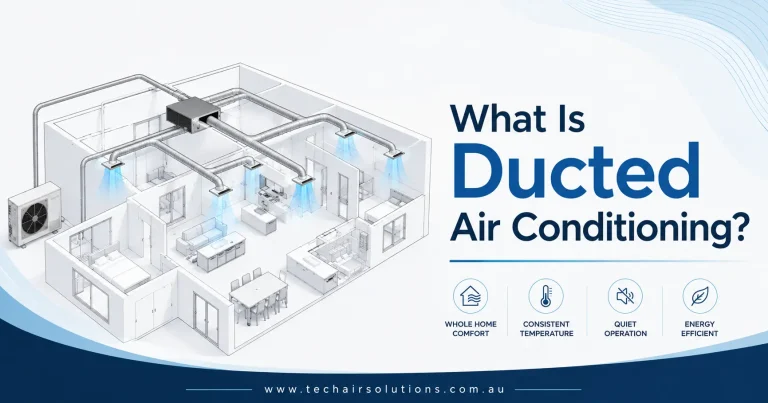
A ducted system uses a single central indoor unit, most commonly installed in the roof cavity, connected to a network of insulated ducts that distribute conditioned air through ceiling vents to every room in the home. A single outdoor unit handles the refrigerant cycle. The only visible components inside the home are ceiling vents and a wall-mounted controller, which gives the home a clean, uncluttered look.
Most ducted systems installed today include zone control, which allows you to nominate which areas receive conditioned air and which don’t. This is what makes ducted systems energy-efficient in practice: rather than conditioning every room all day, you activate only the zones in use.
Advantages of Ducted Air Conditioning
Whole-home comfort from one system. One system, one controller, and consistent temperatures across every room. For families with different areas in regular use throughout the day, this is genuinely hard to replicate with split systems.
Aesthetically clean. Because the main unit is in the roof and the only things visible are vents, ducted systems suit modern and architecturally designed homes far better than wall-mounted units in every room.
Quiet operation indoors. The main unit and compressor sit well away from living spaces. What you hear inside is gentle airflow from the vents, not the fan noise associated with a wall-mounted split system.
Smart zoning for targeted efficiency. Modern ducted systems with proper zone control allow you to cool only occupied areas, reducing energy consumption significantly compared to conditioning the whole home at once.
Adds value to the property. Ducted air conditioning is widely regarded as a value-adding feature in the Australian property market, particularly for homes in the three-bedroom-plus bracket.
Best outcome when installed during a build or renovation. If you’re building a new home or undertaking a major renovation, installing ducted from the outset is considerably more cost-effective than retrofitting it later.
Disadvantages of Ducted Air Conditioning
Higher upfront cost. Ducted systems start at around $8,000 for a small home and commonly reach $12,000 to $20,000 or more for larger properties. This is the primary reason many homeowners opt for split systems instead.
Requires suitable roof cavity access. The indoor unit needs to sit in the roof space, and the ductwork needs room to run through the ceiling. Homes with flat roofs or shallow ceiling voids may not be suitable without significant additional work.
More expensive and disruptive to retrofit. Fitting a ducted system into an existing home involves opening ceiling cavities and doing significant installation work. It’s far more straightforward in a new build.
Professional servicing is essential. Because the main unit and ductwork are hidden, maintenance requires a technician rather than just cleaning a filter yourself.
Higher running costs if zoning isn’t used. A ducted system running across the whole home without proper zoning can use considerably more energy than needed. Without proper use of zoning features, a ducted system can use three to four times more electricity than a split system. This isn’t a problem with ducted systems in general, but it is a real consequence of poor setup or usage habits.
How Do the Costs Actually Compare?
Upfront Installation Costs
|
System Type |
Approximate Cost (Supply and Install) |
|
Single split system (2.5-5.0 kW) |
$1,300 to $4,000 |
|
Multi-split system (2-3 zones) |
$4,500 to $9,000 |
|
Ducted system, small home (up to 120m²) |
$8,000 to $13,000 |
|
Ducted system, medium home (160-220m²) |
$12,000 to $18,000 |
|
Ducted system, large home (220m²+) |
$18,000 to $30,000+ |
Prices are indicative estimates for standard residential installations in NSW. Actual costs vary by brand, access conditions, and electrical requirements.
The comparison shifts when you start thinking about whole-home coverage. A home with four bedrooms plus a living area might need five separate split systems to match the coverage a single ducted system provides. At $2,000 to $3,500 per split system installed, that’s $10,000 to $17,500 in split systems alone before you factor in multiple outdoor units on the exterior of the home.
Split system or ducted? Get the right advice before you choose.
Not sure which air conditioning system suits your home, layout, and comfort needs? Tech Air Solutions can assess your space and recommend the right option for reliable year-round comfort.
Running Costs: Which Is Cheaper to Operate?
This is where the comparison gets nuanced, because the honest answer depends entirely on how you use the system.
Ducted systems may be more efficient in large homes where multiple rooms are used regularly, whereas split systems can be cost-efficient when used to cool only the bedroom at night or a living area during the day.
The Australian Government’s Energy Rating data gives some useful real-world context. For a medium house of 160 square metres, a 3.5-star multi-split reverse cycle air conditioner costs approximately $90 per year in cooling costs, while a 3-star ducted refrigerated system (not zoned) costs approximately $125 annually. Once you add zoning to the ducted system, that gap narrows considerably.
A useful rule of thumb:
- If you regularly use one or two rooms at a time: A split system will almost certainly cost less to run.
- If you regularly condition four or more rooms simultaneously: A well-zoned ducted system becomes competitive and can cost less than running multiple split systems at once.
- If your ducted system isn’t zoned: Running it without zone control across the whole home costs significantly more than targeted split system use.
The best temperature settings also play a major role in running costs for both system types. Keeping to 25°C to 26°C in summer and 20°C to 21°C in winter saves approximately 10% per degree compared to more aggressive settings.
Which System Is Easier to Install?
Split systems are significantly simpler to install. A standard single-room installation typically takes three to six hours and involves minimal disruption to the home. There’s no roof access required, no ceiling modification, and no duct design work. For existing homes and rentals (with landlord permission), split systems are by far the more practical option.
Ducted systems are a more involved process. The indoor unit needs to be lifted into and suspended in the roof cavity, ductwork needs to be laid out and connected to each zone, ceiling vents need to be cut, and the whole system needs to be commissioned and pressure-tested. A typical home installation takes one to two days, while larger or more complex homes can take three days or more.
The most important factor in ducted installation is timing. If you’re building a new home or undertaking a significant renovation, this is the ideal window to specify ducted air conditioning. The ductwork goes in before the ceiling does, dramatically reducing cost and disruption. Retrofitting ducted into an established home is achievable, but it involves accessing the roof cavity and cutting into existing ceilings, both of which add time, cost, and mess to the job.
Running Costs, Efficiency, and Energy Star Ratings
Both systems can be highly energy-efficient when they’re properly sized, correctly installed, and used sensibly. The energy star rating on the unit’s label is the most reliable guide to comparing models.
Under Australia’s Zoned Energy Rating Label (ZERL), which came into effect in April 2020, split systems are rated across three climate zones (hot, average, and cold) rather than a single national figure. This makes it easier to compare performance in your specific region. Each additional star on the energy rating can reduce running costs by up to 10%, so comparing star ratings between shortlisted models is well worth the time.
Inverter technology matters significantly in both system types. An inverter system adjusts its output continuously to maintain a set temperature, rather than cycling on and off at full power. This reduces electricity consumption and wear on the compressor, and it’s now standard across most quality brands including Daikin, Mitsubishi Electric, Fujitsu, Panasonic, and LG.
For ducted systems specifically, zoning is the efficiency multiplier. Using zoning to cool only occupied areas can potentially cut energy usage by up to 50% compared to conditioning the whole home continuously. A ducted system without proper zone control is like running every light in the house when you’re only sitting in one room.
Maintenance: What Each System Requires
Split System Maintenance
Split systems are relatively straightforward to maintain, and a significant portion of the ongoing maintenance is genuinely DIY-friendly.
The most important task is cleaning the indoor air filter every four to six weeks during heavy use. A blocked filter restricts airflow, reduces efficiency, raises running costs, and can cause the evaporator coil to freeze, which in turn can cause water leaks. Our step-by-step air conditioner cleaning guide walks through the whole process.
Beyond filter cleaning, the outdoor unit should be kept clear of vegetation and debris, and a professional service once a year covers the tasks you can’t safely do yourself: checking refrigerant levels, cleaning coils, testing electrical connections, and inspecting the condensate drain.
Ducted System Maintenance
Ducted systems have a return air filter, accessible via the return air grille in the ceiling, which needs the same regular cleaning as a split system filter. This is the one maintenance task the homeowner can manage themselves.
Beyond that, ducted systems require a licensed technician for servicing because the main unit and ductwork are in the roof cavity. The technician will inspect the indoor unit, clean the evaporator coil, check refrigerant levels and all duct connections, and test zone dampers and the controller.
Annual professional servicing is the standard recommendation. For properties on the Central Coast and coastal areas, where salt air and humidity accelerate component wear, sticking to a consistent annual schedule is particularly important.
One consideration that often goes unmentioned: because the main unit and ducting are hidden in the roof cavity, problems can develop without being obvious. A slow refrigerant leak or a duct that has come loose at a joint may not be noticed until the system starts performing poorly or, in the case of a duct issue, a ceiling water stain appears. This is one reason why annual servicing isn’t optional for ducted systems, it’s the only reliable way to catch developing issues before they become expensive.
Noise Levels: Indoor vs Outdoor
Both systems produce noise, but in different locations.
A split system’s indoor unit generates fan noise in the room it’s serving. Modern units from premium brands are considerably quieter than older models, but you will hear the unit operating, particularly at night in a quiet bedroom. The outdoor compressor also produces noise, which matters if it’s positioned near a bedroom window or an outdoor entertaining area.
A ducted system’s main unit and compressor are physically separated from living spaces. The only sound inside the home is the gentle airflow from the vents, which most people find unobtrusive. For households where noise is a genuine concern, particularly in bedrooms, this can be a meaningful advantage for ducted.
Choosing Between Split System and Ducted: Which Suits Your Situation?
Rather than declaring one system universally better, here’s a practical decision guide:
|
Your Situation |
Recommended System |
|
Apartment, unit, or small home (1-2 bedrooms) |
Split system |
|
Renting (with landlord approval) |
Split system |
|
Budget under $5,000 |
Split system |
|
Only cooling 1-3 specific rooms regularly |
Split system |
|
New build or major renovation |
Ducted |
|
Large home (4+ bedrooms) needing whole-home coverage |
Ducted |
|
Prioritise aesthetics and minimal interior impact |
Ducted |
|
Multiple family members using different areas simultaneously |
Ducted |
|
Retrofitting to an existing established home on a moderate budget |
Split system (multiple) |
|
Builder or developer specifying for new homes |
Ducted |
What About Multi-Split Systems?
A multi-split system sits between a single split system and a full ducted setup. One outdoor compressor connects to multiple indoor units, typically two to five, spread across different rooms. This gives you individual room control without the complexity and cost of full ductwork.
Multi-split systems cost more than a single split system but typically less than a ducted setup, depending on the number of indoor units. They’re a practical middle ground for medium-sized homes where whole-home ducted feels excessive but installing separate outdoor units for every room isn’t desirable.
The trade-off is that if the shared outdoor unit develops a fault, all indoor units are affected simultaneously, whereas individual split systems fail independently.
Split System vs Ducted on the Central Coast, Tuggerah, and Surrounds
Across the NSW Central Coast, both systems are commonly installed, but the region’s mix of property types and climate conditions creates some clear patterns worth understanding.
In the established suburbs of Wyong, Berkeley Vale, Charmhaven, and Lake Haven, where many homes are 20 to 40 years old and were not built with ducted systems in mind, split systems are the most practical choice for most owners. Roof cavities in older homes can present access challenges, and the construction activity involved in retrofitting full ductwork isn’t always justified relative to the cost.
In the newer residential estates spreading across Warnervale, Wadalba, and Hamlyn Terrace, where land releases are creating significant volumes of new builds, ducted systems are increasingly being specified from the outset. Builders and developers in this corridor are responding to buyer expectations for whole-home comfort and clean aesthetics, and the straightforward integration of ductwork during construction makes it the logical choice.
Coastal properties from The Entrance through Bateau Bay and Toowoon Bay benefit from the quieter indoor operation of ducted systems, but the outdoor condensing unit needs thoughtful placement to minimise salt air exposure. For split systems in these locations, the same applies: outdoor units should be kept away from direct ocean-facing exposure where possible, and annual servicing is particularly important to check for corrosion on fins and coils.
For commercial premises along the Tuggerah Business Park corridor and the wider Westfield Tuggerah precinct, multi-zone ducted systems or commercial-grade multi-split setups are the standard approach, providing the consistent temperature control that retail and office environments require without the visual distraction of multiple wall units.
Conclusion
The split system vs ducted air conditioning question doesn’t have a single right answer, because the right choice depends entirely on your property and how you live in it.
Split systems win on upfront cost, installation simplicity, and targeted efficiency for smaller spaces or households that primarily use one or two rooms at a time. Ducted systems win on whole-home coverage, aesthetics, quiet operation, and total cost of ownership for larger homes where multiple rooms are in regular simultaneous use.
The most common mistake people make is choosing based on upfront price alone. A split system is cheaper to buy today, but if you end up installing five of them to cover a large home, the combined cost approaches or exceeds what ducted would have cost, with more outdoor units on the exterior and more visible wall units inside.
The best approach is to have a qualified professional assess your home before committing either way. They’ll take into account your roof cavity access, home layout, how you actually use the space, and the total cost of ownership over the system’s lifespan, which will give you a much clearer picture than any general comparison guide can.
Compare ducted and split system air conditioning services.
Learn more about both system types and choose the right air conditioning solution for your Central Coast home.