If you’ve been researching commercial or large-scale air conditioning and come across both “VRV” and “VRF”, you might have assumed they’re two competing technologies. They’re not. The short answer is that VRV and VRF are two names for exactly the same system, and the reason both exist comes down to trademark law rather than any technical difference.
This guide explains what these systems actually are, how they work, the different configurations available, where they’re typically installed, and how they compare to more familiar options like ducted and split system air conditioning. By the end you’ll have a clear, practical understanding of whether a VRF system is relevant to your situation.
Why Two Names for the Same Technology?
VRV, which stands for Variable Refrigerant Volume, was developed and trademarked by Daikin Industries in Japan in the early 1980s. As a global leader in HVAC, Daikin introduced this technology to address a genuine problem in commercial air conditioning at the time: existing systems couldn’t efficiently manage varying heating and cooling loads across multiple zones simultaneously without significant energy waste.
The technology proved highly effective, and other major HVAC manufacturers naturally developed their own versions. The issue was that “VRV” was Daikin’s registered trademark, so competitors couldn’t legally use it. They adopted the term VRF instead, which stands for Variable Refrigerant Flow. The two terms describe the same underlying technology. VRF eventually became the more broadly used generic term across the global industry, while Daikin continues to use VRV for its own product range.
So when you see VRV vs VRF discussed anywhere, the distinction is commercial and historical, not technical. A Daikin VRV system and a Mitsubishi or LG VRF system are the same category of technology. For consistency, this guide uses VRF as the general term, which is how most of the Australian HVAC industry refers to these systems today.
What Is a VRF Air Conditioning System?
A VRF system is a large-scale HVAC technology that provides highly efficient, simultaneous heating and cooling to different zones within a building from a single outdoor unit. Think of it as a central nervous system for your building’s climate, but one that responds independently and intelligently to the different needs of each zone at any given moment.
Unlike traditional HVAC systems that maintain a fixed output and are essentially either fully on or fully off, a VRF system uses inverter compressors to continuously vary the flow of refrigerant to multiple indoor units based on the exact demand of each zone. This is the core principle that makes these systems both efficient and flexible.
There are a few foundational principles that define VRF technology:
Refrigerant only. VRF systems use refrigerant as the sole heat transfer medium throughout the system, as opposed to chilled water systems where refrigerant is used in the main plant and chilled water is then circulated to fan coil units around the building. This removes the need for water pumps, cooling towers, and their associated infrastructure.
Inverter compressors. At the heart of every VRF system is an inverter compressor, which adjusts its speed continuously to match the current heating or cooling load. Unlike a conventional compressor that cycles on at full power and then off, an inverter compressor can run at anywhere from 10% to 100% of its capacity, delivering precisely what’s needed at any moment and consuming only the electricity required to do so.
Multiple indoor units on one refrigerant circuit. A single outdoor unit can connect to a large number of indoor units, all sharing the same refrigerant piping network. Each indoor unit operates independently, controlled by its own thermostat or controller.
Modular scalability. VRF systems can be expanded over time by adding additional outdoor or indoor units, which is particularly useful for buildings that grow in stages.
How a VRF System Actually Works
Understanding the operational logic of a VRF system is more straightforward than its technical reputation suggests.
The system starts in standby. When a user turns on one of the indoor units via its controller, the outdoor unit receives the signal and begins operating. It evaluates the current outdoor temperature and the operating requirements of the indoor unit (mode, set point, fan speed), then starts the compressor at exactly the output level required to meet that demand.
When a second indoor unit is turned on, the outdoor unit recalculates the total requirements of all active indoor units and adjusts the compressor output accordingly. This calculation is continuous and automatic. As conditions change throughout the day, whether that’s outdoor temperature rising, additional zones being activated, or occupancy levels changing, the system responds in real time.
Users control the system through the same inputs you’d use on any air conditioner: on/off, mode selection (cool, heat, fan, dry, auto), set point temperature, and fan speed. The sophistication is in what happens behind the scenes, not in how complicated it is to use.
The ability to respond dynamically to changing outdoor conditions is one of the primary reasons VRF systems perform more efficiently than traditional chiller-based or fixed-output commercial systems, particularly in climates like the NSW Central Coast where temperatures can swing significantly between morning and afternoon.
Find the right VRV or VRF system
for your building.
Get professional advice on system design, zoning and installation for your commercial property on the Central Coast.
The Key Components of a VRF System
Outdoor Unit
The outdoor unit contains the inverter compressor and condenser coil. Unlike a standard split system outdoor unit that serves just one or two indoor units, a VRF outdoor unit can be connected to a large number of indoor units, sometimes 20, 30, or more depending on the system’s capacity. For very large installations, multiple outdoor units can be combined to form a larger capacity system while still operating as a single integrated network.
The outdoor unit is modular in design, which allows it to be positioned in locations that would be difficult for conventional plant equipment, including rooftops, carparks, and plant rooms.
Indoor Units
VRF indoor units come in a wider variety of types than standard residential split systems. This flexibility is one of the technology’s practical advantages for commercial spaces:
- Ceiling cassettes: Mounted flush in a suspended ceiling, distributing air in four directions. A common choice for open-plan offices, retail spaces, and hotel lobbies.
- Ducted indoor units: Concealed in ceiling cavities and connected to supply air outlets throughout the space, providing a traditional ducted appearance from inside the room.
- Wall-mounted units: Similar in appearance to residential split systems, suited for individual offices, server rooms, or areas requiring targeted airflow.
- Floor or ceiling-mounted units: A practical option in spaces with limited ceiling access, such as server rooms or plant areas.
All of these indoor unit types can exist on the same VRF refrigerant network simultaneously, which gives architects and building designers significant flexibility when planning the fit-out of a new or refurbished building.
Refrigerant Piping and Refnet Joints
The refrigerant piping network connects the outdoor unit to all indoor units. At the branch points in the piping, Refnet joints (copper distributors) split the refrigerant flow to direct it toward multiple indoor units. The piping carries both refrigerant and communication signals, and the network must be designed carefully to ensure appropriate pressure and flow distribution across all connected units.
For heat recovery VRF systems (explained below), three pipes are used in the distribution network: a high-pressure gas line, a low-pressure liquid line, and a return refrigerant line. This three-pipe configuration is what enables simultaneous heating and cooling in different zones.
Communication Lines and Control
Each indoor unit connects back to the outdoor unit via communication wiring, forming a closed-loop network. This is an essential feature of VRF design, as the continuous data exchange between outdoor and indoor units is what enables the dynamic, load-matched operation that defines the technology.
Control options range from individual wired controllers on each indoor unit, to centralised building management system (BMS) integration that allows all units to be monitored and managed from a single interface. Modern VRF systems from major brands also support web-based and smartphone monitoring and control.
Types of VRF Systems
Cooling-Only VRF
The simplest configuration. All indoor units can operate in cooling mode, along with fan and dry modes. Not commonly specified in Australia where year-round comfort requires heating capability, but used in some commercial applications where a separate heating system is already in place.
Heat Pump VRF
The most commonly installed VRF type in Australia. All indoor units can operate in either cooling or heating mode, giving year-round climate control from a single system. The limitation is that the entire system must be in either cooling or heating mode at any given time, though individual units can be switched off independently. This suits most standard commercial buildings where the dominant need is either cooling or heating at any particular time of year.
Heat Recovery VRF
The most sophisticated and capable configuration. Heat recovery systems use the three-pipe arrangement to allow different zones to simultaneously cool and heat, completely independently of each other. In practical terms, this means a south-facing office that needs heating in the morning can receive heat while a west-facing boardroom that’s receiving direct sun at the same time is being cooled, all from the same outdoor unit.
This simultaneous heating and cooling capability is genuinely useful in large or multi-tenancy commercial buildings where different areas have different solar loads and occupancy patterns throughout the day. The recovered heat from cooling zones is redirected to heating zones rather than being expelled outside, which also improves overall system efficiency.
Need help choosing the right air conditioning system?
Speak with Tech Air Solutions for professional advice on VRV, VRF, ducted and commercial air conditioning systems across the Central Coast.
VRF vs Ducted Air Conditioning
For commercial building owners and property developers, the comparison between VRF and conventional ducted air conditioning is a meaningful one. Both systems can serve commercial buildings effectively, but they suit different scales and contexts.
Ducted split systems typically cost $150 to $250 per square metre installed. VRF systems cost $250 to $450 per square metre. This means VRF carries a higher upfront capital cost, and for budget-constrained projects, ducted splits deliver functional air conditioning at a lower initial investment.
Where VRF earns back that premium is in:
Energy efficiency across variable loads. A VRF system only delivers the refrigerant flow actually needed in each zone. When some zones are unoccupied or require minimal conditioning, the system adjusts down accordingly. A VRF system can increase energy efficiency by up to 50% compared to a standard HVAC system. This potential saving is most realised in buildings with genuinely varied occupancy patterns across different zones.
Simultaneous heating and cooling. Heat recovery VRF is the only refrigerant-based system that can cool one zone while heating another simultaneously. Ducted systems cannot do this.
Scalability and flexibility. VRF systems can be expanded by adding outdoor or indoor units without replacing the entire system, whereas expanding a conventional ducted system often requires a new plant and distribution network.
Design flexibility. The variety of indoor unit types, from cassettes to concealed ducted units to wall mounts, allows VRF to adapt to almost any interior design brief without dictating the room’s appearance.
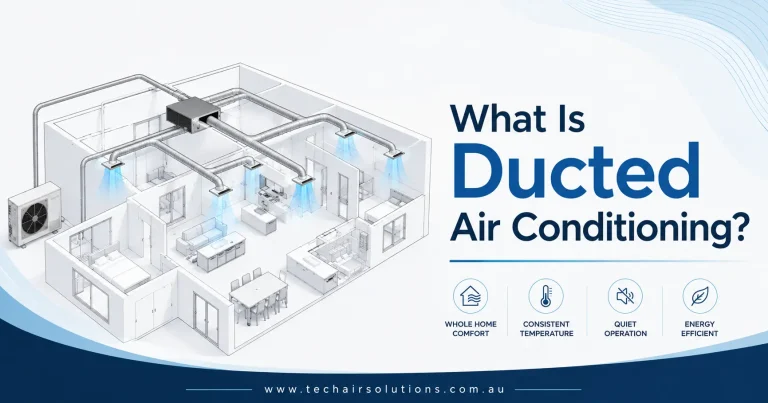
For residential applications, conventional ducted or split systems remain the more cost-effective choice for most homeowners. Our guide comparing split system and ducted air conditioning covers that residential comparison in detail. VRF begins to make more compelling sense at commercial scale, where the higher capital cost is spread across a larger installation and the running cost advantages accumulate over a longer operational period.
Where VRF Systems Are Typically Used in Australia
VRF is primarily a commercial and large-scale technology in the Australian market. Common applications include:
Commercial office buildings. Multi-floor office buildings with varying occupancy across different areas and floors are an ideal fit for VRF, particularly heat recovery systems. Different tenancies can be independently controlled and metered.
Hotels and accommodation. Each guest room or suite can have individual climate control from a shared system, with unoccupied rooms consuming minimal energy. Hotel lobbies, restaurants, and conference facilities can all be on the same VRF network.
Retail and mixed-use developments. Large retail centres or mixed-use buildings with a combination of retail tenancies, food and beverage, and office space benefit from the zone-specific control and the ability to match conditioning to varied occupancy patterns across the building throughout the day.
Healthcare facilities. Clinics and medical facilities require precise zone control and the ability to independently condition spaces with very different requirements, from waiting rooms to consulting rooms to procedure areas.
Schools and educational facilities. Classrooms with variable occupancy benefit from VRF’s load-matching capability. Heat recovery systems are particularly efficient in school environments where some spaces need heating (early morning, shaded classrooms) while others need cooling (sun-facing classrooms during the middle of the day).
Large residential projects. High-end residential buildings, multi-unit developments, and large custom homes sometimes specify VRF, particularly where individual apartment metering or exceptionally precise climate control is a requirement. For a home with five bulkheads on a VRV system, quotes typically range around $25,000, while entry-level residential VRF installations with a single outdoor unit and two indoor units start around $14,000.
VRF and Australian Compliance Considerations
For commercial projects in Australia, VRF systems above certain capacities trigger specific compliance requirements under the National Construction Code (NCC) 2025 Section J energy efficiency provisions and AS 1668.2:2024 ventilation standards.
VRF systems commonly exceed 40 kW total capacity, and a dedicated outdoor air system or economy cycle provision is required to comply with NCC 2025 Section J. Minimum outdoor air ventilation rates must be provided regardless of system type, neither ducted splits nor VRF indoor units introduce outdoor air on their own. A separate outdoor air system must supply 10 L/s per person in offices under AS 1668.2:2024.
Pipe insulation, fan power limits, and time-switch controls also apply. For any commercial project involving VRF, engaging a mechanical engineer or specialist HVAC consultant during the design phase is essential to ensure the system specification meets all relevant Australian standards before installation commences.
Maintenance Requirements for VRF Systems
VRF systems require professional maintenance from technicians with specific training in the brand’s equipment. Because these systems are considerably more complex than residential split or ducted systems, fault diagnosis and servicing require proprietary diagnostic tools and software provided by the manufacturer.
Typical maintenance tasks include:
- Inspecting and cleaning all indoor unit filters across the network
- Checking refrigerant pressure and leak-testing all pipe joints
- Cleaning indoor and outdoor coils
- Testing all communication lines and controller functions
- Verifying compressor operation and inverter performance
- Inspecting condensate drainage across all indoor units
For large installations with dozens of indoor units, annual servicing is a multi-day job that should be factored into the total cost of ownership at the planning stage. Some brands offer remote monitoring platforms that allow facilities managers to track performance and receive fault alerts without requiring a technician on site for routine checks.
For comparison, the maintenance requirements of standard residential systems are considerably simpler. If you’re managing a residential or small commercial property with conventional split systems, our DIY air conditioner maintenance guide covers what you can manage yourself and what requires a professional.
Conclusion
VRV and VRF are the same technology under different names, one trademarked by Daikin, the other adopted by the rest of the industry. Both describe a sophisticated air conditioning approach that uses inverter compressors and variable refrigerant flow to independently condition multiple zones from a single outdoor unit, delivering efficiency, flexibility, and precise climate control at a scale that conventional systems cannot match.
For commercial buildings, healthcare facilities, hotels, educational campuses, and large mixed-use developments, VRF represents the current benchmark for multi-zone climate control in Australia. The higher upfront cost is offset by lower running costs over the system’s lifespan, the flexibility of heat recovery operation, and the ability to scale the system as the building’s needs evolve.
For residential homeowners and smaller commercial premises, the technology is generally over-specified for the application. A well-designed ducted or multi-split system delivers excellent comfort at a more appropriate cost for those contexts.
If you’re considering a VRF system for a commercial project on the Central Coast or are unsure whether your building’s scale and requirements justify it over conventional ducted or multi-split options, a detailed assessment from a licensed commercial HVAC specialist is the best starting point.