Ask most Australians what they want from a home cooling system and the list is pretty consistent: comfortable in summer, useful in winter, not too expensive to run, and ideally one appliance doing all of the above. That description maps almost exactly onto what a reverse cycle air conditioner does, which is why it has become the dominant choice for residential climate control across the country.
Despite how common they are, a lot of people aren’t entirely sure what “reverse cycle” actually means, or what separates it from a regular air conditioner or a standard split system. This guide answers those questions clearly and gives you everything you need to understand how these systems work, why they’re efficient, what types are available, and how to choose the right one for your situation.
What Is a Reverse Cycle Air Conditioner?
A reverse cycle air conditioner is a system that can both cool your home in summer and heat it in winter using the same unit and the same underlying technology. The “reverse cycle” part of the name refers to the ability to reverse the direction of the refrigerant flow, which switches the system between cooling mode and heating mode.
Unlike conventional heaters which create heat from an energy source, a reverse cycle air conditioner works by absorbing and moving heat rather than generating it, making it far more efficient.
In cooling mode, the system draws heat out of the indoor air and transfers it outside, leaving the room cooler. In heating mode, the cycle reverses: the system extracts heat energy from the outdoor air, even when it feels cold outside, and transfers it into the room. This ability to move heat rather than generate it from scratch is what gives reverse cycle systems their efficiency advantage over resistive electric heaters, gas heaters, and basic cooling-only units.
How Does a Reverse Cycle Air Conditioner Work?
The technology at the core of every reverse cycle system is the refrigerant cycle, the same fundamental process used in refrigerators. Understanding this cycle makes it clear why these systems can heat and cool so efficiently.
The Four Key Components
Compressor: The compressor pressurises the refrigerant and drives it around the circuit. In modern systems, this is an inverter compressor that adjusts its speed continuously to match the current demand, rather than cycling on and off at full power.
Evaporator coil: Located in the indoor unit. In cooling mode, cold refrigerant flows through the evaporator coil. Warm room air passes over the coil and its heat is absorbed by the refrigerant, cooling the air before it’s circulated back into the room.
Condenser coil: Located in the outdoor unit. In cooling mode, the refrigerant releases the heat it absorbed from your room to the outdoor air through the condenser coil.
Expansion valve: This component controls the flow of refrigerant between the high-pressure and low-pressure sides of the circuit, allowing the refrigerant to expand and drop in temperature before reaching the evaporator coil.
Cooling Mode
When you set the system to cool:
- Warm indoor air is drawn into the indoor unit and passes over the cold evaporator coil.
- The refrigerant absorbs the heat from the air, cooling it.
- The cooled air is recirculated into the room.
- The now-warm refrigerant travels to the outdoor unit where it releases the absorbed heat to the outside air via the condenser coil.
- The refrigerant cycles back inside to repeat the process.
Heating Mode: The Reversal
In heating mode, the system reverses the refrigerant flow using a component called the reversing valve. The outdoor coil now acts as the evaporator (absorbing heat from outside air) and the indoor coil acts as the condenser (releasing that heat into the room).
This is the part most people find surprising: the system can extract useful heat from outdoor air even when temperatures are quite low. In heating mode, the unit draws outside heat and distributes it indoors, even when it’s cold outside, as many modern units are designed to operate effectively even in sub-zero conditions thanks to built-in defrost modes and advanced outdoor coil design.
The outdoor air doesn’t need to feel warm for this to work. As long as there’s some heat energy in the air (which there is, even at low temperatures), the refrigerant can absorb it and the system can transfer it indoors.
Reverse Cycle vs. Cooling-Only Air Conditioners
The term “air conditioner” is used loosely in Australia to refer to both cooling-only units and reverse cycle systems. The difference matters significantly when you’re making a purchase decision.
| Feature | Cooling-Only Air Conditioner | Reverse Cycle Air Conditioner |
|---|---|---|
| Cooling capability | Yes | Yes |
| Heating capability | No | Yes |
| Typical unit cost | Lower | Slightly higher |
| Year-round usefulness | Summer only | All seasons |
| Need for separate heater | Yes | No |
| Energy efficiency for heating | N/A | High (transfers heat rather than generating it) |
| Best suited for | Climates with minimal winter | Most Australian climates |
For the vast majority of Australian homes, reverse cycle makes clear sense. The marginal extra cost over a cooling-only unit is quickly offset by the elimination of a separate heater, and the running cost advantage of heat transfer over heat generation is substantial over a full year.
Cooling-only units are mainly practical in parts of northern Australia where winters are genuinely mild enough that heating is never required.
Get expert advice on system type, capacity and energy efficiency for reliable year-round comfort in your Central Coast home.
Difference Between Reverse Cycle vs. Electric Heaters and Gas
This is one of the most compelling practical arguments for reverse cycle air conditioning, and it’s worth understanding properly.
These units stand out because of how efficiently they move heat: one kilowatt of electricity can produce three or more kilowatts of heating or cooling.
The technical way to express this is the Coefficient of Performance (COP). A COP of 3 means the system produces 3 kW of heating output for every 1 kW of electricity consumed. By comparison:
| Heating Method | Heating Output per kW of Electricity |
|---|---|
| Electric resistance heater (bar heater, panel heater) | 1 kW (100% efficiency) |
| Gas heater | Equivalent of approximately 0.7 to 0.9 kW depending on gas price |
| Reverse cycle air conditioner | 2.5 to 5+ kW depending on model and conditions |
The numbers are stark. A reverse cycle system in heating mode typically delivers two to five times the heating output per dollar of electricity compared to a resistive electric heater. Space heating and cooling accounts for over 50% of residential energy use in the average Australian home, so the running cost difference between these options is meaningful over a full year.
This efficiency advantage is also relevant to the environment. When powered by renewable energy or from a solar PV system, reverse cycle air conditioning is among the lowest-emission heating options available to Australian households.
Types of Reverse Cycle Air Conditioning Systems
Reverse cycle technology is available across all the main air conditioning system formats. The choice of system type determines how many rooms you can condition and how the system is installed, not the underlying reverse cycle capability.
Reverse Cycle Split System
The most common setup in Australian homes. One indoor wall-mounted unit connects to one outdoor unit. The indoor unit handles a single room or open-plan zone. Most split systems sold in Australia today are reverse cycle as standard.
A single-split system consists of one outdoor unit connected to one indoor unit and is suitable for heating or cooling a single room or open-plan area.
Reverse cycle split systems are available in capacities ranging from 2.5 kW (suitable for a small bedroom) up to 9 kW or more (suitable for large open-plan living areas). Getting the capacity right for your room is important. Our guide on what size air conditioner you need covers how to calculate the appropriate kW rating for your specific space.
Reverse Cycle Multi-Split System
A multi-split system has one outdoor unit connected to multiple indoor units, suitable for heating or cooling multiple rooms or whole-of-home.
This configuration lets you cover two to five rooms from a single outdoor unit while maintaining individual control over each indoor unit. It’s a practical middle ground between a single split system and a full ducted installation.
Reverse Cycle Ducted System
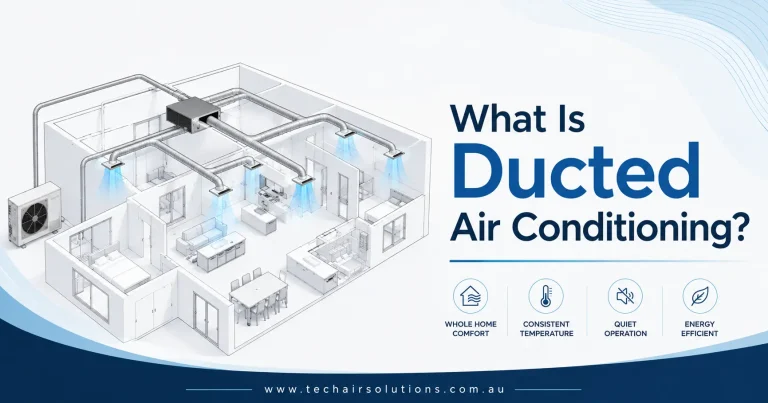
A ducted system consists of one central outdoor unit connected to multiple indoor rooms through ducts and vents, providing whole-home heating and cooling.
The indoor unit sits in the roof cavity and distributes conditioned air through a network of insulated ducts to ceiling vents in every room. The only components visible inside the home are the ceiling vents and a wall controller. For a detailed explanation of how ducted systems work and what they cost, our guide on what ducted air conditioning is covers the full picture.
Comparison: Reverse Cycle System Types
| System Type | Coverage | Approx. Cost (Supply and Install) | Best Suited For |
|---|---|---|---|
| Single split system | One room or zone | $1,300 to $4,000 | Bedrooms, single living areas, small homes |
| Multi-split system | 2 to 5 rooms | $4,500 to $9,000 | Medium homes, multiple rooms without ducted |
| Ducted system | Whole home | $8,000 to $20,000+ | Large homes, new builds, renovations |
The Role of Inverter Technology
Most modern reverse cycle air conditioners use inverter technology in their compressors, and it’s worth understanding why this matters for both comfort and running costs.
A conventional (non-inverter) compressor operates in a binary way: it’s either running at full speed or it’s off. Once the room reaches the set temperature, the compressor switches off. When the temperature drifts, it switches back on at full power. This cycling creates slight temperature swings and uses more energy per cycle because starting and stopping a compressor is less efficient than continuous operation.
Inverter technology adjusts compressor speed to match the required load, rather than simply switching on/off. That means fewer temperature swings, quieter operation and lower energy use.
An inverter compressor ramps down to a low speed to maintain the set temperature rather than cycling off completely. The result is more stable temperatures, lower electricity consumption during the maintenance phase, and less mechanical wear on the compressor over time. Almost all quality reverse cycle split systems sold in Australia today use inverter technology, but it’s worth confirming when comparing models.
Understanding the Energy Star Rating
All reverse cycle air conditioners sold in Australia must display an energy rating label. Since April 2020, split systems have used the Zoned Energy Rating Label (ZERL), which replaced the older single star rating.
Reverse cycle air conditioners display a zoned energy rating label. The label provides information on energy consumption of the product based on the climate it is installed in. Products are star rated for both heating and cooling. The more stars a product has, the less energy it will use.
The ZERL rates the system separately for three climate zones across Australia: hot, mixed, and cold. This is more useful than a single national rating because the same unit can perform quite differently in Darwin versus Canberra. When comparing models, look at the star rating for the climate zone that most closely matches where you live.
Key points when reading the label:
- Heating and cooling are rated separately, and the star count for each may differ.
- Higher stars mean lower running costs per year.
- The label also shows estimated annual energy consumption in kWh.
- Noise levels (measured in dB) are also shown on current labels.
For most of coastal NSW, the “mixed” zone rating is the most relevant reference point when comparing products.
Reverse Cycle Refrigerants: R32 vs R410A
If you’ve been researching reverse cycle systems, you may have noticed references to the refrigerant type, specifically R32 and R410A. This is worth understanding briefly.
R410A was the dominant refrigerant in Australian residential air conditioning for many years. R32 has become the new standard across most brands and models because it has a significantly lower global warming potential (GWP). Newer models use low-GWP refrigerants like R32, offering environmental benefits alongside the performance advantages of modern inverter technology.
R32 also operates at slightly higher pressures than R410A, which allows for more compact system designs and, in some configurations, slightly improved efficiency. When comparing current models, R32 is the expected standard for quality split systems from major brands.
Reverse Cycle and Indoor Air Quality
Beyond heating and cooling, reverse cycle air conditioners also filter the air passing through the system. Standard units include a mesh filter that captures dust, pollen, and larger airborne particles, improving air quality compared to having no filtration at all.
Premium models from several manufacturers include more advanced filtration options, including activated carbon filters for odours, HEPA-style filters for fine particles, and ionisation or UV-C systems for bacteria and mould. Some models carry the Sensitive Choice certification from the National Asthma Council Australia, indicating they meet standards relevant to people with asthma and allergies.
Maintaining the filter is important for both air quality and system performance. A clogged filter restricts airflow, reduces efficiency, and in more serious cases can cause the evaporator coil to ice over. Our guide on how to clean your air conditioner covers the full process for keeping filters and the rest of the system in good condition. During peak use, filters should typically be cleaned every four to six weeks.
How Efficiently Does Reverse Cycle Heating Work in Cold Weather?
A common concern is whether reverse cycle heating remains effective when it’s genuinely cold outside. The answer depends on the unit.
Entry-level models may see a meaningful reduction in heating capacity when outdoor temperatures drop below 5°C. Higher-end models from brands like Daikin, Mitsubishi Electric, and Panasonic are engineered to maintain effective heating output down to minus 10°C or lower, using more advanced compressor technology and low-ambient heating algorithms.
In most of coastal Australia, including NSW, outdoor temperatures rarely approach those extremes for extended periods, so this is a less critical consideration than it would be for alpine or inland regions. It’s still worth checking a product’s rated heating capacity at low ambient temperatures (usually listed in the specifications as capacity at 2°C outdoor temperature) if you live in an area with genuinely cold winters.
Most reverse cycle systems also have a built-in defrost cycle. When the outdoor unit’s coil gets cold enough that frost begins to form on it during heating operation, the system briefly reverses to melt the ice before returning to heating mode. You may notice this as a short period of reduced airflow from the indoor unit, sometimes accompanied by steam from the outdoor unit. This is completely normal.
Choosing the Right Reverse Cycle System for Your Home
A few key decisions determine which system is right for your situation.
System Type
Do you need to condition one room, a few specific rooms, or the whole home? A single split system is the right answer for targeted comfort. Multiple rooms without whole-home coverage suit a multi-split. Whole-home comfort, particularly in a larger or new home, points toward ducted. The full breakdown of these options is covered in our split system vs ducted air conditioning comparison guide.
Sizing: Getting the Capacity Right
A system that is too small may not be able to properly heat or cool your home on the coldest and hottest days. A system that is too large will cost more to buy and may cost more to run. Larger systems tend to be less efficient and can result in large temperature swings, reducing comfort.
As a general reference point, the Victorian Government’s energy guidance provides the following sizing guide for split systems:
| Room Size | Example | Recommended Capacity |
|---|---|---|
| Small (up to 20m²) | Bedroom, study | 2.5 to 3.0 kW |
| Medium (21 to 40m²) | Bedroom with ensuite, small lounge | 3.0 to 5.0 kW |
| Large (41 to 60m²) | Lounge, large kitchen | 5.0 to 8.0 kW |
| Very large (over 60m²) | Open-plan areas | 8.0 kW and above |
These figures are a starting point. The actual required capacity depends on ceiling height, insulation quality, window area and orientation, and your local climate. A professional assessment by your installer will give you a more accurate figure for your specific space. The best way to correctly size your reverse cycle air conditioner is for your installer to conduct an onsite load assessment and calculation.
Energy Star Rating
When comparing models, prioritise the star rating for your climate zone. Each additional star typically means meaningfully lower annual running costs. For a system that runs daily across both summer and winter, the cumulative saving over the system’s lifespan is significant.
Features Worth Considering
Wi-Fi connectivity: Allows remote control via smartphone and the ability to pre-condition the home before you arrive.
Sleep mode: Gradually adjusts temperature overnight, reducing electricity use while you sleep. Running your system at the right temperature settings overnight makes a genuine difference to your power bill across a season.
Timer functionality: Lets you schedule the system to turn on before you need it and off when you leave.
Advanced filtration: Worthwhile for households with allergy sufferers or respiratory conditions.
Noise rating: Check the dB rating on the energy label if the system will be in a bedroom or near a neighbour’s property boundary.
Warranty
Under the Victorian Energy Upgrades program, all reverse cycle air conditioners must be covered by a minimum 5-year warranty. Some warranties are conditional on scheduled servicing by appropriately qualified personnel. Always read the warranty conditions carefully and speak to your installer about what the coverage actually includes.
While the VEU program is specific to Victoria, the 5-year warranty benchmark it sets is a useful reference across Australia. Most reputable brands offer 5-year product warranties on their residential reverse cycle systems. Extended warranties on specific components (particularly compressors) are also available from some manufacturers and worth considering for higher-capacity systems.
Speak with Tech Air Solutions about correct system sizing, efficient installation and the best reverse cycle option for your property.
Maintaining Your Reverse Cycle System
A reverse cycle air conditioner that is well maintained runs more efficiently, lasts longer, and is less likely to develop the faults covered in our air conditioner not blowing cold and air conditioner freezing up troubleshooting guides.
Filter cleaning (DIY): Every four to six weeks during heavy use. The single most impactful maintenance task a homeowner can do.
Outdoor unit clearance (DIY): Keep vegetation trimmed back and remove debris from around the outdoor condenser. Ensure adequate clearance on all sides for airflow.
Annual professional service: A licensed technician will check refrigerant levels and pressure, clean the evaporator and condenser coils, inspect the condensate drain, and test all electrical connections and controls. This is the maintenance you cannot do yourself and it genuinely extends system life.
Conclusion
Reverse cycle air conditioning is the practical answer to Australia’s climate: one system that handles year-round heating and cooling efficiently, from a single unit that installs once and serves you for 15 to 20 years with proper care.
The efficiency advantage over electric resistance heaters is substantial. The versatility over cooling-only air conditioners is clear. And with modern inverter technology, low-GWP refrigerants, and smart features becoming standard across the market, current reverse cycle systems deliver meaningfully better performance and lower running costs than systems installed even 10 years ago.
The most important decisions when choosing a system are getting the type right for your home’s layout (split, multi-split, or ducted), sizing it correctly for each space, and selecting a model with a strong energy star rating for your climate zone. Everything else follows from those three fundamentals.